SYS_01
Semantic Context Cache
Vertebra fingerprints the codebase, persona, and model into one SHA-256 signature. Matching context is recalled instead of uploaded and billed again.
Vertebra / Anatomical Context Map
Scroll-controlled system inspection
The architecture between your code and its intelligence.
Context is infrastructure
Most coding assistants resend the same repository context with every prompt. Vertebra registers large contexts once, recalls them by signature, and bills only the work that changed.
Six systems / One command surface
Vertebra fingerprints the codebase, persona, and model into one SHA-256 signature. Matching context is recalled instead of uploaded and billed again.
Workspace indices, histories, and telemetry remain inside a WAL-mode SQLite database. Repository sync is never part of the system.
A multi-threaded Rust watcher detects writes and deletions within milliseconds, keeping the active context synchronized with the work in front of you.
Map the exact frontend, backend, documentation, or system files a task requires. Include global standards once and activate them anywhere.
Paste screenshots, wireframes, and visual references directly beside your instruction. Image context travels with the selected codebase modules.
A purpose-built Markdown lexer renders long technical answers, line-numbered code, tables, and images without a heavy parsing runtime.
Vertebra converts selected project structure into a clean reasoning substrate—then chooses the cheapest valid way to transmit it.
Five deterministic operations
One continuous context path
Read only the modules and global context enabled for the current task.
Wrap topology and source files in an explicit XML reasoning boundary.
Hash model, persona, and payload into one deterministic context signature.
Register large contexts once; reuse the active six-hour semantic lease.
Stream the response while recording precise usage metadata locally.
Structured context / XML sandbox
Files, topology, global standards, and the active persona are separated explicitly—so source code stays source code and the instruction stays the instruction.
01 <workspace_topology root="VERTEBRA">
02  src/tauri/database.rs
03  src/tauri/fs_agent.rs
04  src/components/MarkdownBlock.tsx
05 </workspace_topology>
06
07 <global_context_file name="ULIX_DESIGN_SYSTEM.md">
08  Editorial terminal constraints loaded.
09 </global_context_file>
10
11 <cache_state
12  signature="sha256:5f2...c91"
13  lease_remaining="273m"
14  cached_tokens="1,222,867"
15 />
16
Native desktop / React 19 + Tauri v2
No browser tabs. No repository upload ritual. Vertebra keeps the project ledger, module map, personas, model controls, telemetry, and technical output inside one exacting native interface.
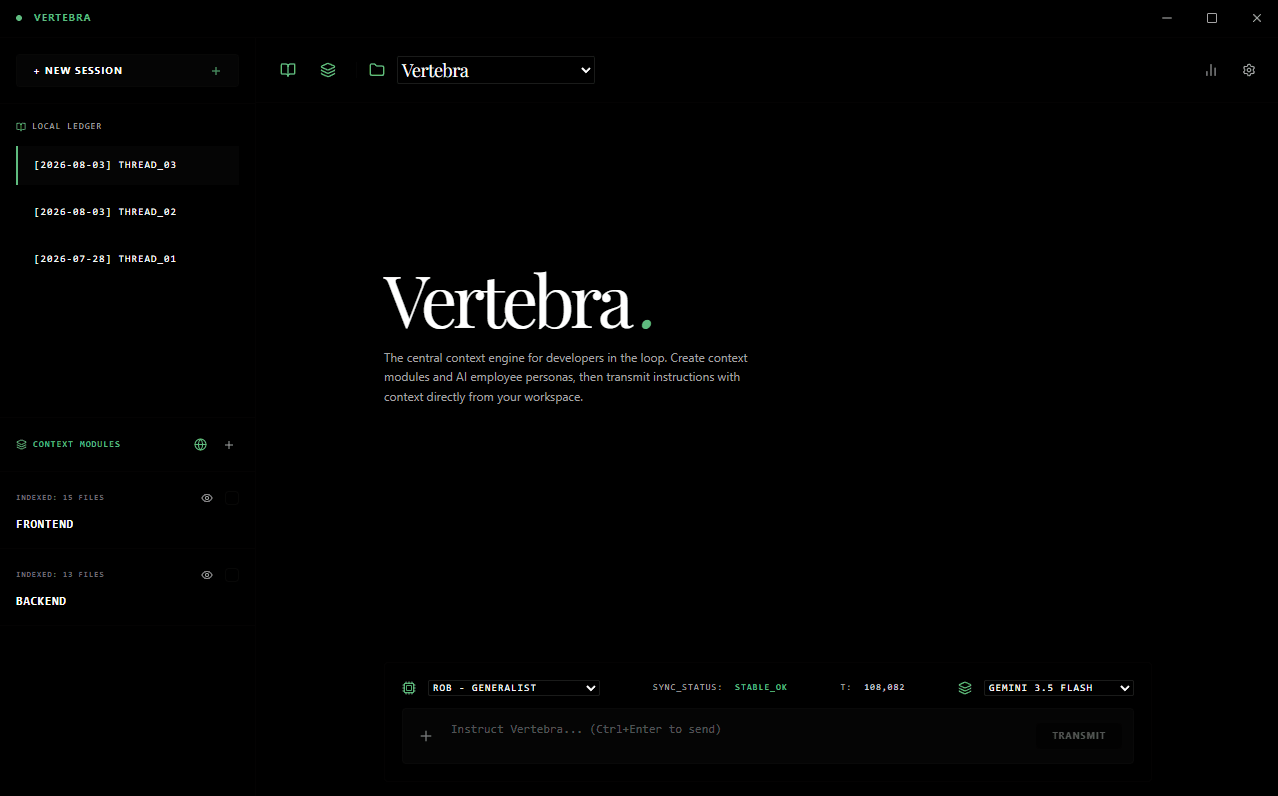
Map modules, switch personas, select the model, and transmit complete project context without leaving the native workspace.
Zero-trust credential boundary
macOS Keychain, Windows Credential Manager, and Linux Secret Service.
API keys are requested on demand and never written into application storage.
Histories, mappings, and state are partitioned by local workspace identity.
Dead remote cache handles are purged automatically before inline recovery.
Compiled specification / v0.1.0
Bring local architecture, durable context, and precision telemetry into one native developer system.
Request accessIntelligent Software for an intelligent future.